It’s the question the whole sector is asking — sometimes out loud, often in silence. Since the emergence of Midjourney, Stable Diffusion, and their architecture-specialized offshoots, a quiet unease has settled over visualization professionals: what if these tools made ArchViz studios obsolete? The question deserves an honest answer — neither in denial nor in catastrophizing.
What generative AI can do — and it’s already a lot
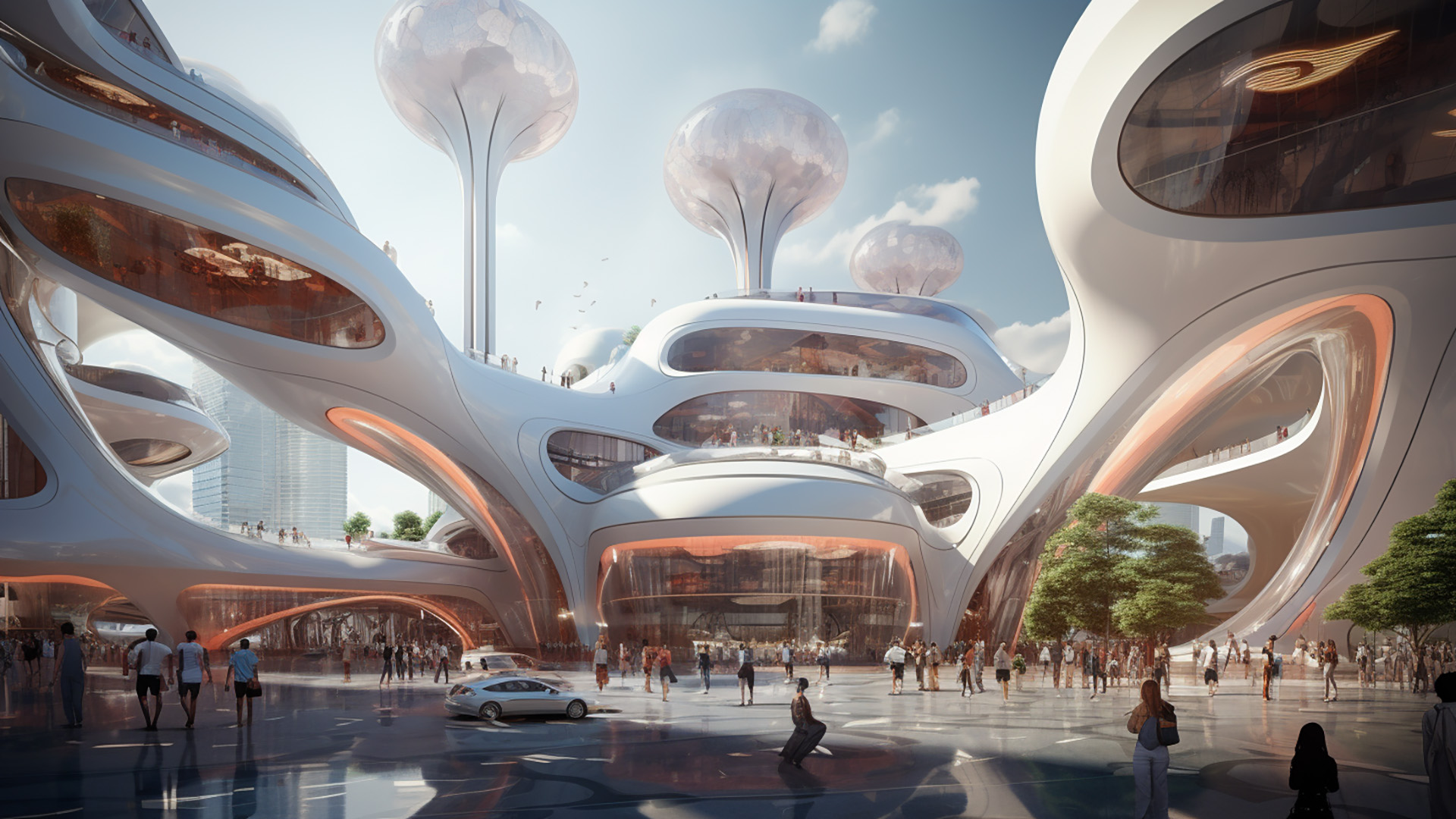
It would be dishonest to downplay the current capabilities of generative AI tools. In a few seconds, a well-formulated prompt in Midjourney can produce a visually seductive architectural image, with a coherence of atmosphere, light, and materials that would have taken hours of work just three years ago. For ideation, moodboarding, or stylistic exploration phases, these tools have become formidably effective.
Platforms like Veras or Maket.ai push this logic further by integrating AI directly into the architectural design workflow — generating plans, façades, and formal variations from programmatic constraints. The time saved in the upstream phase is real and undeniable.
For certain low-end uses — quick illustrations for social media, internal presentation visuals, conceptual sketches — generative AI can today produce an acceptable result without going through a specialized studio.
What generative AI can’t do
This is where the nuance becomes essential. Because behind the impressive aesthetic façade of AI-generated images lie structural limits that sector professionals identify immediately.
Fidelity to the real project
A generative AI tool doesn’t know your project. It generates a plausible, aesthetically coherent image — but one that isn’t your building. The proportions are approximate, the architectural details invented, the materials interpreted rather than reproduced. For a developer who has to market a precise program, for an architect defending a project before a jury or committee, this approximation is disqualifying.
A professional render is a faithful representation of a real project, with its exact dimensions, its chosen materials, its documented context. It’s a communication document that engages the responsibility of whoever produces it. Generative AI, in its current state, can’t keep that promise.
Technical coherence
AI-produced images frequently suffer from inconsistencies that a trained eye detects easily — impossible reflections, contradictory shadows, slightly distorted perspectives, constructive details that wouldn’t hold up in reality. These artifacts are acceptable for an inspiration board. They’re disqualifying for a professional communication visual.
Iterative control
Working with a visualization studio is a back-and-forth process — brief, interim validation, adjustments, delivery. At each stage, the client can steer, correct, refine. Generative AI works differently: the result is probabilistic, hard to control precisely, and targeted changes remain complex to obtain without regenerating the image from scratch. When a client says « I’d like the same render but with a stone façade rather than concrete and late-afternoon light, » a studio executes. AI interprets — with unpredictable results.
Complex formats
Cinematic animations, interactive virtual tours, 360° panoramas, VR experiences — generative AI doesn’t address these deliverables. These formats require complete 3D modeling, a configurable render engine, and a production chain that current generative tools can’t replace.
AI as a tool, not a competitor
The question may not be « will AI replace studios? » but « how will the studios that intelligently integrate AI outpace those that don’t? »
At Parallax Stud.io, we use generative AI tools — for conceptual exploration in the upstream phase, for quickly dressing raw 3D views, for generating atmospheric variants, for speeding up certain post-production steps. These tools make us faster and more responsive on some tasks. They don’t replace the modeling, staging, and post-production work that forms the core of our craft.
It’s the difference between a surgeon who uses an assistance robot and a robot that replaces the surgeon. Technology augments human skill — it doesn’t supplant it, at least not where precision, responsibility, and aesthetic judgment are at stake.

What the future holds — honestly
It would be unwise to claim that generative AI’s capabilities won’t evolve. They will, that’s certain. Tomorrow’s tools will probably be able to generate images more faithful to a precise project, handle more complex formats, and integrate more deeply into professional workflows. Research led by institutions like the MIT Media Lab or companies like Autodesk is actively exploring these territories.
But it’s equally likely that these advances will first benefit the studios that have learned to master these tools — rather than the tools themselves doing away with studios. The history of creative technologies rarely shows total substitution: Photoshop didn’t kill photographers, AutoCAD didn’t replace architects, and real-time 3D didn’t end visualization studios.
What disappears are the players who refuse to evolve. What takes hold are those who integrate new technologies without losing sight of what makes their work valuable: precision, aesthetic standards, and the ability to serve a real project with a clear narrative intent.
Parallax Stud.io: human standards, augmented by technology
At Parallax Stud.io, we chose to integrate generative AI into our workflow — as a tool of exploration and acceleration, never as a substitute for the technical rigor and architectural eye that underpin the quality of our work. If you want visuals that faithfully represent your project and convince your audience, contact us.
Parallax Stud.io is a French-Moroccan architectural visualization studio based in Rabat. We help developers, architects, and real-estate agencies bring out the visual value of their projects.