
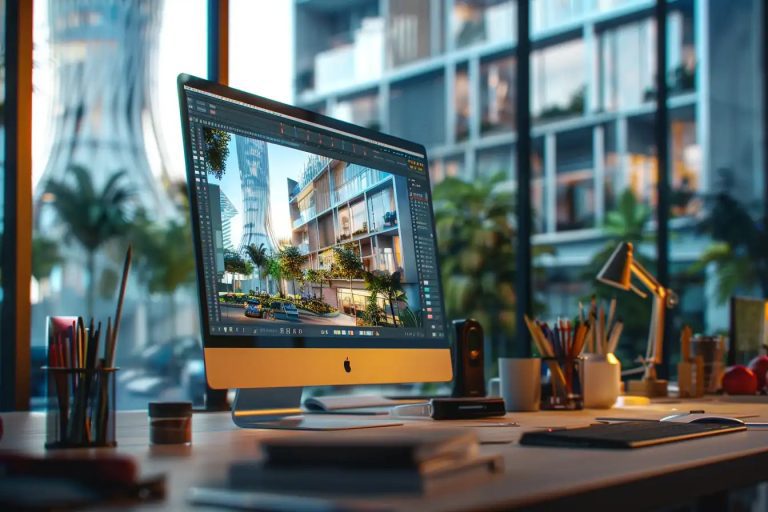
Interior render, exterior render: two disciplines, two logics
You might think producing an architectural render is always the same exercise — model, light, render. In reality, an interior render and an exterior render don’t draw on the same skills, don’t answer the same expectations, and aren’t judged by the same criteria. Understanding these differences means choosing better what you commission — and evaluating better what you receive.
Interior rendering: above all a question of atmosphere
A successful interior render doesn’t just show a room. It creates a feeling. The viewer’s eye has to enter the space, feel the warmth of soft light, the texture of a floor finish, the density of a fabric. That’s precisely what makes the exercise demanding: in an enclosed space, there’s nowhere to hide. Every surface is scrutinized, every cast shadow tells something.
Light, the heart of the battle
Indoors, artificial light plays a central role. Unlike outdoors, where the sun naturally structures the scene, the lighting of an interior space must be entirely designed and simulated: recessed spots, wall lights, indirect light, halos on surfaces. Render engines like V-Ray or D5 Render can now simulate the physical behavior of light with remarkable precision — provided you know how to set them up.
Materials, at the core of believability
A tile that doesn’t reflect the way it should, a fabric that looks too plastic, a wood without depth — and the whole credibility of the render collapses. The work on textures, roughness maps, reflections, and transparencies often represents the majority of production time on a high-end interior render. It’s invisible work for the end client, but immediately noticeable when it’s done badly.
Framing, an editorial choice
Indoors, the choice of viewing angle is decisive. Too wide a shot distorts proportions. Too tight, and it loses the spatial context. The best interior renders draw on the codes of architectural photography published in magazines like Wallpaper* or Dezeen — slightly low-angle viewpoints, balanced compositions, attention to vanishing lines.
Exterior rendering: composing with the real world
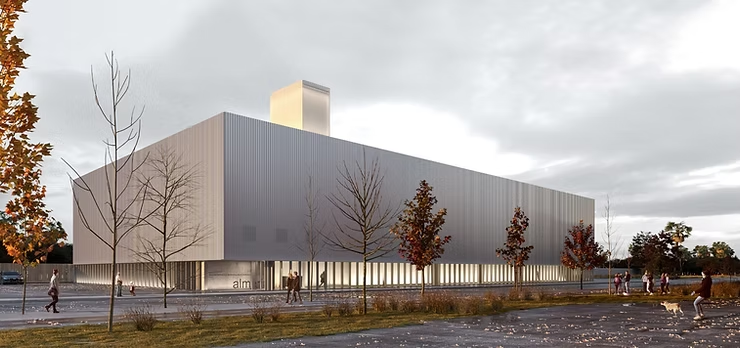
Exterior rendering poses challenges of a different nature. The space is open, the project has to fit into a context — urban, natural, suburban — and natural light, though more intuitive to simulate, is also more demanding in terms of coherence.
Contextual integration, an often-underestimated challenge
A building set in a void will convince no one. The project’s surroundings — roads, vegetation, adjacent buildings, sky — must be treated with as much care as the building itself. It’s this integration work that gives the render its credibility and lets the client project the future into the present. Asset libraries like Quixel Megascans or Maxtree provide high-quality resources to populate these environments convincingly.
Natural light and its variations
Unlike interiors, exteriors play on multiple temporalities. The same building doesn’t tell the same story at high noon, in late afternoon, or at nightfall. The choice of sun position, cloud cover, and implied season is a narrative choice as much as a technical one. Residential projects often gain from being shown in golden hour. Commercial or institutional projects inspire more confidence in clear, crisp daylight.
People and elements of life
An exterior render without human life can feel cold and unengaging. Adding people, vehicles, and lively terraces helps anchor the project in everyday reality and makes it easier for the client to project themselves into it. It’s a delicate balance — too many figures overload the scene, too few and the project looks uninhabitable.
Interior or exterior: which visual communication strategy?
The question shouldn’t be « which type of render should I choose? » but « what story do I want to tell? »
For a developer marketing apartments, interior renders of the living spaces — living room, kitchen, master bedroom — are often more decisive than façade views. The buyer is first buying a way of living.
For an architect in a competition or permit phase, exterior renders and site views are essential. They show how the project fits into its territory.
For a high-end project, combining the two remains the most complete strategy — and the most convincing.
Parallax Stud.io: interiors and exteriors handled with the same standard
At Parallax Stud.io, we work on both high-definition interior renders and contextualized exterior views. Every project gets careful thought about angle, light, and atmosphere before production even begins — because a good render is conceived before it’s produced.
Contact us to discuss your visual needs and get a quote tailored to your project.
Parallax Stud.io is a French-Moroccan architectural visualization studio based in Rabat. We help developers, architects, and real-estate agencies bring out the visual value of their projects.