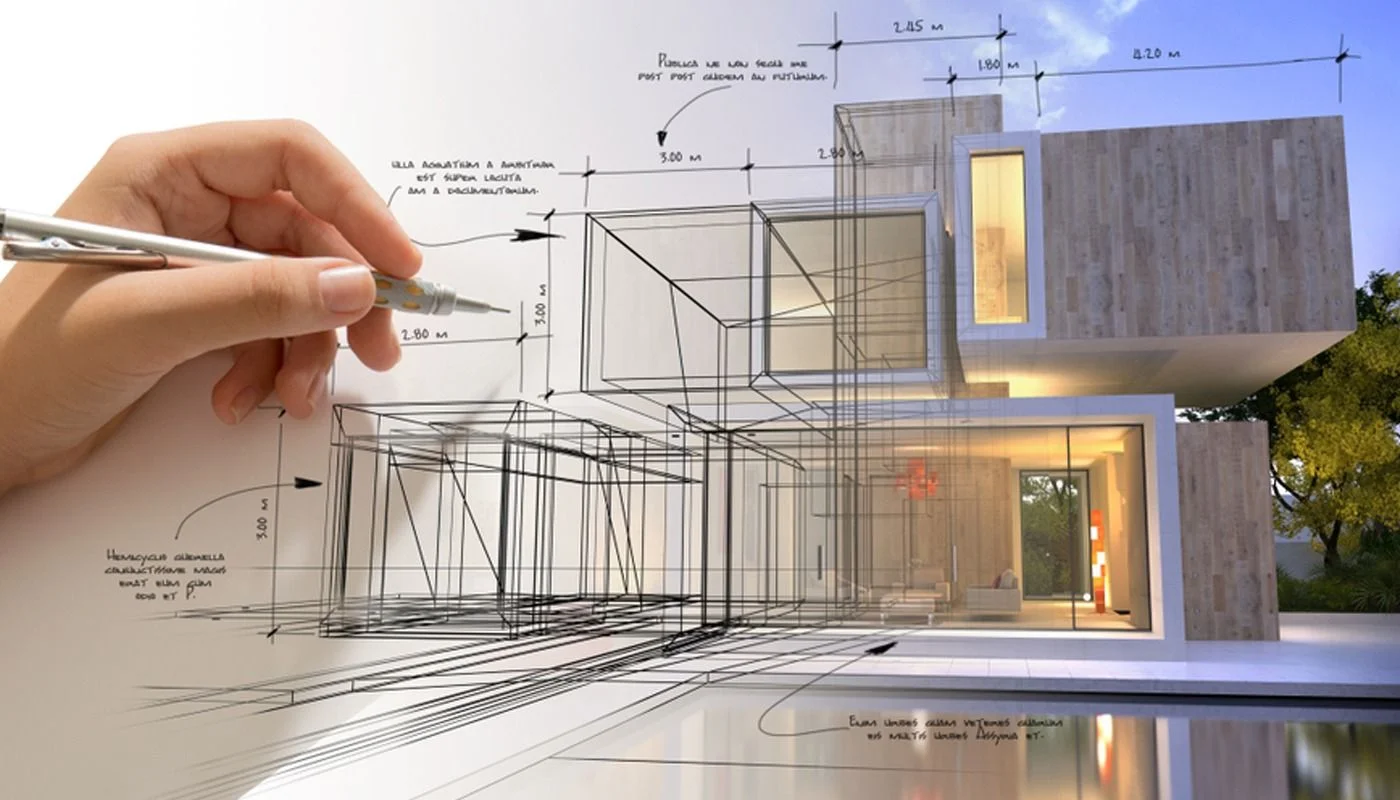
An architectural project isn’t born directly in its final form. It’s built in stages — through trial and error, back-and-forth, successive decisions that gradually refine an initial intent until it becomes concrete reality. Each phase has a specific visual communication need, different stakeholders, distinct requirements. And yet many clients and architects only call on a visualization studio at the very end of the process — to dress up an already-frozen project.
It’s a missed opportunity. Architectural visualization is far more useful when it accompanies the project from its beginnings.
Phase 1 — The sketch: exploring without committing
This is the freest moment of the project, and often the most decisive. The architect explores formal directions, tests layouts, weighs design choices. At this stage, no one expects photorealistic images — that would actually be counterproductive. What’s needed is fast, evocative representations that allow options to be compared without investing hours of production in each.
This is where generative AI tools and conceptual renders find their natural place. From sketches, visual references, or a description of intent, it’s possible to produce in a few hours a series of boards that give form to several architectural directions — precise enough to fuel a discussion, flexible enough to be questioned.
For the client, these upstream visuals have considerable value: they let them get involved in design choices before anything is set in stone. Adjustments at this stage cost infinitely less — in time and money — than changes requested after the permit is filed.
Phase 2 — The preliminary design: convince and validate
The project takes shape. The major options are settled, the plans begin to stabilize. This is the phase where you need to convince — the client, the financial partners, sometimes local officials or residents within a public consultation.
The renders produced at this stage are validation tools as much as communication ones. They must be precise enough to faithfully reflect the project’s intentions while remaining able to incorporate changes if discussions shift certain choices. A preliminary-design render isn’t a marketing render — it’s more schematic, more direct, focused on volumes, the main materials, and the fit within the context.
It’s also the ideal phase to produce isometric diagrams, perspective sections, and concept diagrams that explain the project in its logic rather than its final appearance. These documents speak to non-specialists without betraying the project’s complexity.
Phase 3 — Permit filing and competitions: defending the project
Whether before a building-permit committee or a competition jury, the project has to defend itself visually in a competitive context. Decision-makers see many submissions — visual quality is never the only criterion, but it influences the overall perception of the project and the confidence it inspires.
A competition file illustrated with polished renders communicates two things at once: the architectural quality of the project, and the team’s ability to master and showcase it. A jury doesn’t only read plans — it feels the project’s ambition through its representations.
For building permits, photomontages inserting the project into the real site are often required or strongly recommended. These documents, which overlay the project onto a photograph of the existing site, make it possible to assess the future building’s visual impact in its immediate context — and to reassure committees about the project’s proper integration.
Phase 4 — Marketing: driving sales
This is the best-known phase, the one renders are most often commissioned for. For a real-estate developer, marketing visuals are directly tied to sales — they fill brochures, property portals, site hoardings, showrooms, and social media.
At this stage, the standard is at its highest. The renders must be photorealistic, atmospheric, carefully framed. They have to create desire — not just inform. Light, materials, people, vegetation, and the general atmosphere all combine to produce an image that projects the potential buyer into their future life in the home.
It’s also at this stage that immersive formats come into their own: 360° virtual tours for portals and showrooms, cinematic animations for event presentations, VR experiences for trade shows and sales offices. These formats extend the prospect’s engagement time and significantly improve the qualification of sales leads.
Phase 5 — Delivery and post-project communication
The building is delivered. The visualization project doesn’t necessarily stop there. Presentation renders for the architect’s portfolio, visuals for the trade press, communication documents for the client — all deliverables that extend the project’s visual life beyond the construction site.
In some cases, a comparison between the renders produced before construction and photographs of the delivered building is powerful communication content — for the architect who wants to highlight how faithful the result is to their initial intent, and for the visualization studio demonstrating the precision of its work.
Why a single partner across all phases changes everything
Using different providers at each phase inevitably creates discontinuities — in render style, in quality, in knowledge of the project. A studio that supports a project from sketch to marketing knows the building in its smallest details. It has followed its evolution, integrated its constraints, understood the architect’s intent. This continuity translates directly into the coherence and quality of the deliverables.
It also translates into efficiency: the 3D models built in the preliminary-design phase are reused and enriched for the marketing renders. Each phase builds on the previous one, without starting from scratch.
Parallax Stud.io: a partner at every stage
At Parallax Stud.io, we work at every phase of the architectural project — from conceptual exploration in the sketch phase to final communication visuals. Our approach is that of a partner who understands the stakes of each stage, not a mere executor waiting for a finalized brief.
If you’d like to discuss the visual strategy of your project — whatever its phase — contact us.
Parallax Stud.io is a French-Moroccan architectural visualization studio based in Rabat. We help developers, architects, and real-estate agencies bring out the visual value of their projects.