In the world of architectural visualization, the choice of render engine is no trivial decision. It’s a commitment that structures a studio’s entire workflow — production speed, deliverable quality, the ability to adapt to client requests, and ultimately, commercial competitiveness. At Parallax Stud.io, that choice fell on D5 Render — and after years of daily practice, in-depth training, and an official certification, we can explain precisely why.
The architectural render engine landscape
Before getting into the detail of D5 Render, it’s useful to set the context. The architectural visualization software market is today structured around a few major players, each with a distinct value proposition.
V-Ray — power at the price of complexity
Developed by Chaos Group, V-Ray has for years been the absolute reference in offline architectural rendering. Its physical accuracy, flexibility, and ability to produce flawless images on the most complex scenes make it a leading tool.
Strengths:
- Exceptional render quality on very complex scenes
- Very fine technical control over every parameter
- Compatible with most modeling software
- Very rich community and documentation
Weaknesses:
- Long, demanding learning curve
- Significant render times, especially without a dedicated render farm
- Non-real-time workflow — every change requires a new compute
- High license cost
- Poorly suited to fast iteration and short-deadline projects
Lumion — accessibility, but with limits
Lumion was one of the pioneers of real-time rendering accessible to architects. Its intuitive interface and large asset library made it widely used in firms.
Strengths:
- Quick to learn
- Good built-in asset library
- Smooth, accessible animations
- Real-time rendering
Weaknesses:
- Recognizable aesthetic that plateaus quickly in photorealism
- Standardized visual results, hard to fine-tune
- Declining performance on very dense scenes
- Regular and costly pricing updates
- Less smooth SketchUp integration than D5 Render
Enscape — excellent in the firm, limited in the studio
Enscape has established itself as architects’ favorite embedded visualization tool, thanks to its direct integration into Revit, SketchUp, Rhino, or ArchiCAD.
Strengths:
- Real-time visualization directly inside the design software
- Ideal for internal project reviews
- Very smooth workflow for architects
- Simple VR export
Weaknesses:
- Insufficient photorealism for high-end external communication visuals
- Limited output resolutions for large formats
- Less precise control of materials and lighting
- A process tool, not a final-communication one
Twinmotion — promising, but not yet at the level
Acquired by Epic Games and built on Unreal Engine, Twinmotion has benefited from considerable investment in recent years and is improving fast.
Strengths:
- Free up to a certain revenue threshold
- Built on the power of Unreal Engine
- Good handling of natural environments
- Continuous, rapid improvement
Weaknesses:
- Photorealism still behind D5 Render
- Less intuitive interface for users from the SketchUp world
- Less stable on complex projects
- Lower-quality asset library than D5 Render
- Less polished SketchUp integration
D5 Render — the detail of what makes the difference
Real-time rendering taken to its highest level
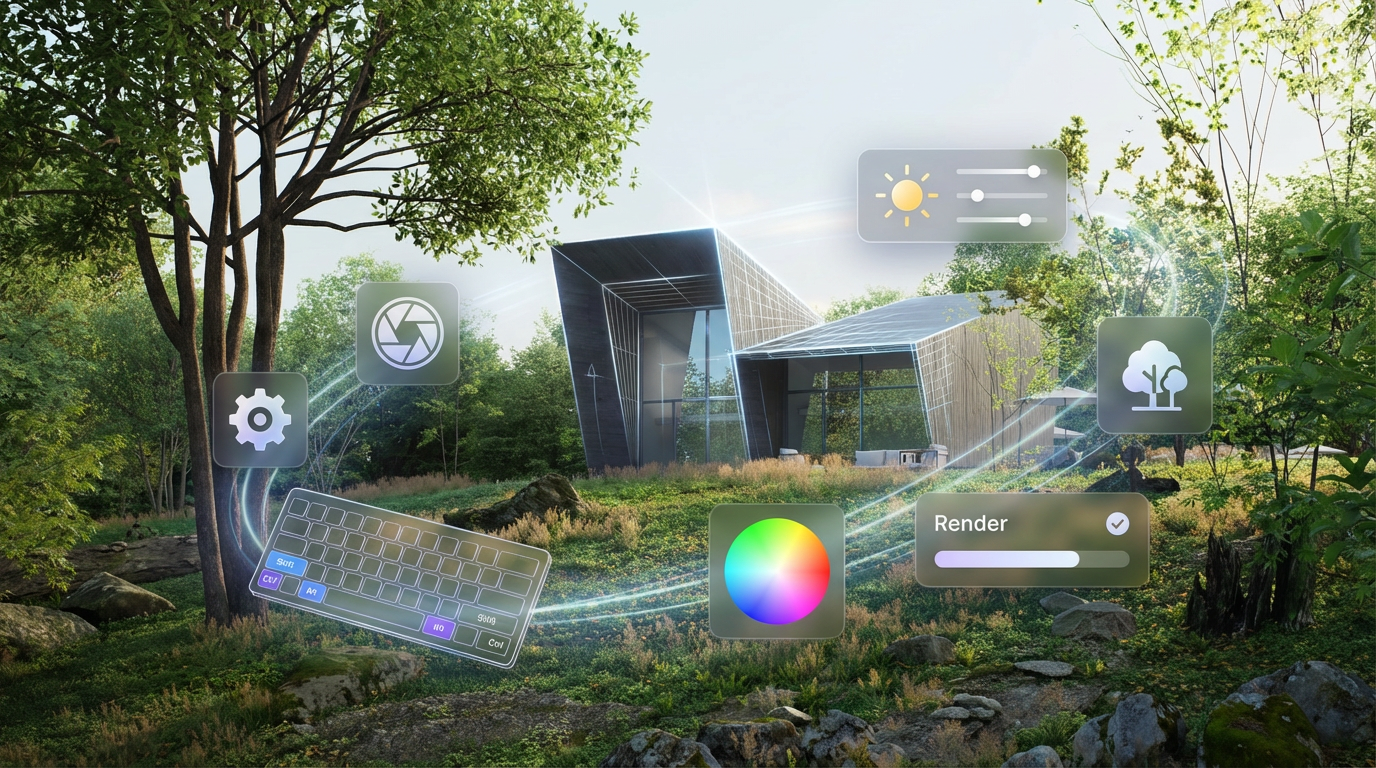
D5 Render is built on a real-time path-tracing engine — meaning the simulation of light’s physical behavior happens live, while you navigate the scene. Reflections, refractions, caustics, soft shadows, indirect light — everything is computed continuously, with no delay between a change and its visible result on screen.
For a visualization studio, this fundamentally changes how you work. Testing a lighting atmosphere, adjusting a material, moving a viewpoint — operations that take a few seconds where other workflows impose compute cycles of tens of minutes. This responsiveness isn’t just a working comfort: it translates directly into iteration capacity, decision quality, and reduced delivery times.
An exemplary smooth SketchUp integration
Our modeling pipeline is built on SketchUp Pro. D5 Render connects to it via a native plugin that synchronizes the two in real time — every change made to the model in SketchUp carries over instantly into D5 Render, with no export, no reconversion, no intermediate handling.
This bidirectional synchronization is one of the most concrete strengths of the D5 + SketchUp workflow. It removes the technical friction between the modeling and rendering phases, and lets you work both in parallel rather than sequentially. On a project with frequent back-and-forth — façade changes, adding a floor, changing the layout — this fluidity represents a considerable time saving.
What the Pro version concretely brings
The Pro version of D5 Render unlocks features that make a measurable difference to production quality and efficiency:
- Output resolutions up to 16K — for large print formats, site hoardings, and big-screen presentations
- Batch rendering — the ability to launch several views in simultaneous rendering, optimizing production times on multi-view projects
- High-resolution animations — video export up to 4K with fine control of the camera path, transitions, and effects
- Built-in 360° panoramas — high-resolution panorama production directly from the software, with no third-party plugin
- Advanced layer and variant management — the ability to create material or state variants on the same scene, for effective comparative deliverables
- Pro asset library — access to an enriched library of high-resolution vegetation, furniture, people, and materials, updated regularly
- Built-in AI features — AI upscaling, denoising, resolution enhancement in post-processing
- Advanced atmospheric effects — volumetric haze, rain, snow, weather variations for realistic, narrative staging
The asset library — an often-underestimated advantage
The quality of an architectural render doesn’t depend only on the building shown. It also depends on everything around it — vegetation, furniture, people, materials, sky. D5 Render offers a native library of several thousand high-resolution assets, covering a wide range of styles and contexts: tropical, Mediterranean, or Nordic vegetation; contemporary or classic furniture; people in context; vehicles; urban or natural environment elements.
The quality of these assets — and particularly the vegetation elements, whose behavior under light is often the weak point of competing engines — contributes directly to the realism and credibility of the scenes produced.
Our expertise — years of practice, an official certification
Choosing the right software is one thing. Mastering it is another. At Parallax Stud.io, we’ve used D5 Render since its first commercial versions, and that depth of practice shows at every stage of production.
We are officially certified by D5 Render — a recognition that attests not only to technical mastery of the software, but to a thorough knowledge of its advanced capabilities, its limits, and production best practices. This certification isn’t symbolic: it represents hours of training, testing, workflow optimization, and continuous upskilling as the software updates.
This expertise translates concretely into three guarantees for our clients:
Quality — we know how to extract the best from the engine on every type of scene. An interior render in artificial light, an exterior in golden hour, a night animation in the rain — each situation calls for specific settings that only deep practice lets you master.
Speed — fine knowledge of the software lets us optimize production times at every stage. We know which parameters to adjust to balance quality and compute time, how to organize a scene so it stays performant, how to anticipate technical problems before they arise.
Adaptability — projects never look exactly like the previous ones. Our mastery of the software lets us answer specific, atypical, or complex requests without improvising — whether a zenithal-light render for a museum project, a twilight animation for a high-end residential program, or a multi-space virtual tour for a hotel being marketed.
A deliberate choice, a recognized expertise
D5 Render isn’t the only architectural render engine capable of producing quality images. But for a studio whose workflow is built on SketchUp, whose mission is to deliver photorealistic visuals on competitive deadlines, and whose ambition is to cover the full range of visualization formats — still render, animation, 360°, VR — it’s today the most coherent tool on the market.
Combined with years of practice and an official certification, it forms the technical backbone of a studio able to meet high expectations, on varied projects, with a consistency of quality our clients can anticipate from the brief.
Parallax Stud.io: D5 Render expertise in service of your project
If you’d like to benefit from this mastery for your next architectural visuals — still renders, animations, virtual tours, or immersive experiences — contact us to discuss your project.
Parallax Stud.io is a French-Moroccan architectural visualization studio based in Rabat, certified D5 Render. We help developers, architects, and real-estate agencies bring out the visual value of their projects.