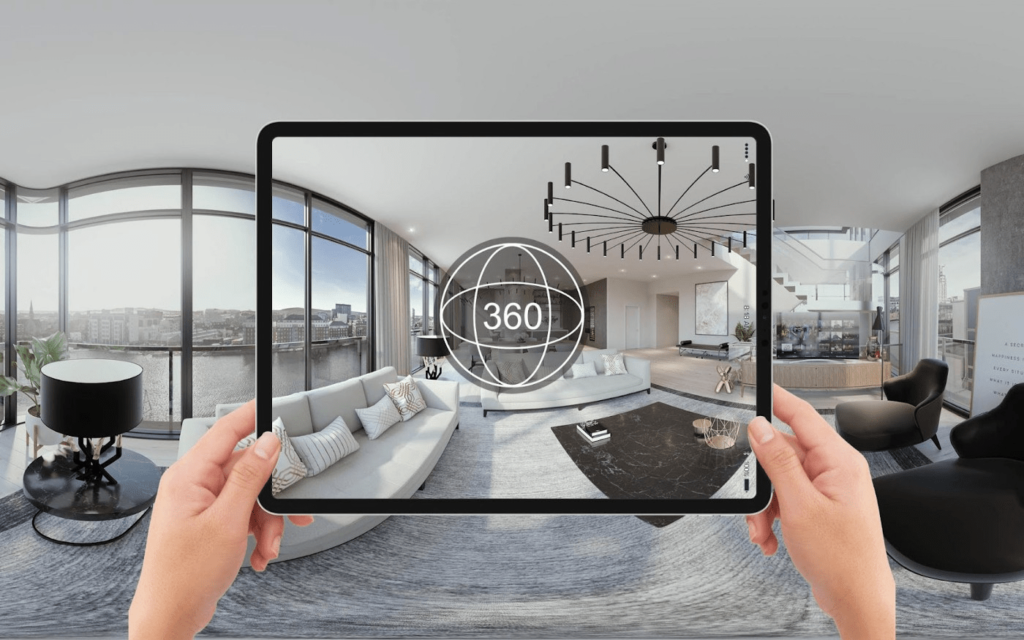
Just five years ago, offering a virtual tour of a property was a marketing gimmick — a nice extra, but not essential. Today, the picture has changed. Buyers research online before they even pick up the phone, foreign investors make decisions remotely, and developers seek to market programs that don’t exist yet. In this context, the 360° virtual tour is no longer a luxury — it’s a concrete answer to very real constraints.
What a 360° tour really changes
The fundamental difference with a still render or a video is the control given to the user. They no longer watch the project — they explore it. They choose where to look, how fast to move, which detail to linger on. This change of posture is far from trivial: several studies show that property listings with a virtual tour generate significantly more engagement than those without. The platform Matterport has published data showing that properties presented in 3D sell on average faster and prompt more inquiries.
It’s not a passing trend. It’s a shift in buyer behavior, accelerated by the pandemic and now embedded in everyday habits.
For new projects, a full-fledged sales tool
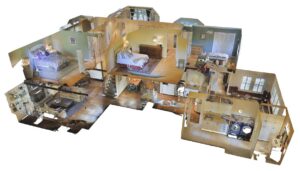
Where the virtual tour really comes into its own is in property development. Selling an apartment off-plan remains a hard exercise: the client has to project, imagine, trust. A 360° virtual tour of a model apartment — not even built yet — dramatically reduces that friction. The prospect no longer buys a dimensioned plan and a few renders: they walk through their future living room, look out the window, gauge the ceiling heights.
For developers, the payoffs are direct:
- Fewer pointless physical visits, and therefore better-used sales time
- Better-qualified prospects — those who request an appointment after a virtual tour are genuinely interested
- Differentiating communication on social media and property portals, where visual quality often makes the difference between a click and a scroll
A technology more accessible than you’d think
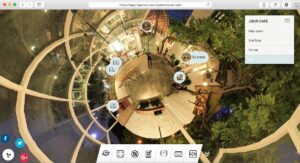
One of the most common barriers is the perception of cost. Many professionals still associate the virtual tour with a heavy investment in hardware and development. In reality, the field has evolved considerably. Distribution platforms like Kuula or Momento360 now make it easy to host and share 360° panoramas, with direct website embedding or a shareable link.
What makes the difference is render quality at the source. A virtual tour built from photorealistic 360° panoramas — generated in CGI for a new project, or captured in high resolution for an existing property — offers an experience incomparable to ordinary photos cropped to 360°.
A few concrete use cases
The developer marketing before delivery — they have no physical property to show, but they can offer a complete tour of the model apartment, with several finish variants accessible in one click.
The agency targeting an international clientele — buyers based abroad can tour a property in Paris, Casablanca, or Dubai from their office, with no plane ticket. The luxury real-estate market confirms that remote purchase decisions are a growing reality in this segment.
The architect in a permit or competition phase — the virtual tour of an unbuilt project can complement a presentation file and make a project more legible for a committee or a non-specialist jury.
What to expect in the coming years
The 360° virtual tour is already mature. What comes next is its gradual integration with other technologies: augmented reality to visualize a project overlaid on its real site, virtual reality for total headset immersion, or real-time customization of materials and fit-outs. Tools like Unreal Engine or D5 Render are making these experiences increasingly accessible to specialized studios, without requiring monumental production budgets.
The question is no longer really whether these tools will take hold — they already are. The question is who will know how to use them with enough mastery and aesthetic sense to turn them into genuine tools of persuasion.
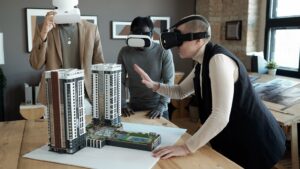
Parallax Stud.io: virtual tours built to convince
At Parallax Stud.io, we produce 360° panoramas and interactive virtual tours from photorealistic 3D renders — for projects in design as well as existing properties. Each tour is built to the same standard as our still renders: image quality, material coherence, careful lighting.
If you’d like to offer your clients an immersive experience that makes the difference, contact us to discuss your project.
Parallax Stud.io is a French-Moroccan architectural visualization studio based in Rabat. We help developers, real-estate agencies, and architects bring out the visual value of their projects.